Back to evidence

AI Native Software Engineering / methodology story

How I helped redesign SDLC delivery for a tier-1 bank

There is a paradigm shift in enterprise software delivery: well-orchestrated technology is necessary, but it is no longer sufficient. To create real impact, AI-native engineering also requires evolved operating models and evolved roles. In this project I helped connect all three dimensions from design to integration.

-40%

target time-to-market reduction

3

transformation levers

6

SDLC phases orchestrated

5d

AI-native operating rhythm

The paradigm shift

AI-native delivery works when technology, roles and operating model evolve together.

My contribution was to help the bank move from a technology adoption question to a complete delivery model: what tools are used, who owns the new work, and which events make the model repeatable inside real squads.

01 / Technology

End-to-end SDLC stack design

I helped design the end-to-end technology stack across all SDLC phases, defining which tools were most appropriate and how they had to be orchestrated so functional teams and developers could access the right AI agents exactly when they needed them.

Planning to production coverageAI orchestration layerHuman validation pointsArtifact-driven delivery
AI-native SDLC technology stack across planning, design, development, testing, deployment and production

01 / Technology

End-to-end SDLC stack design

AI-native SDLC technology stack across planning, design, development, testing, deployment and production

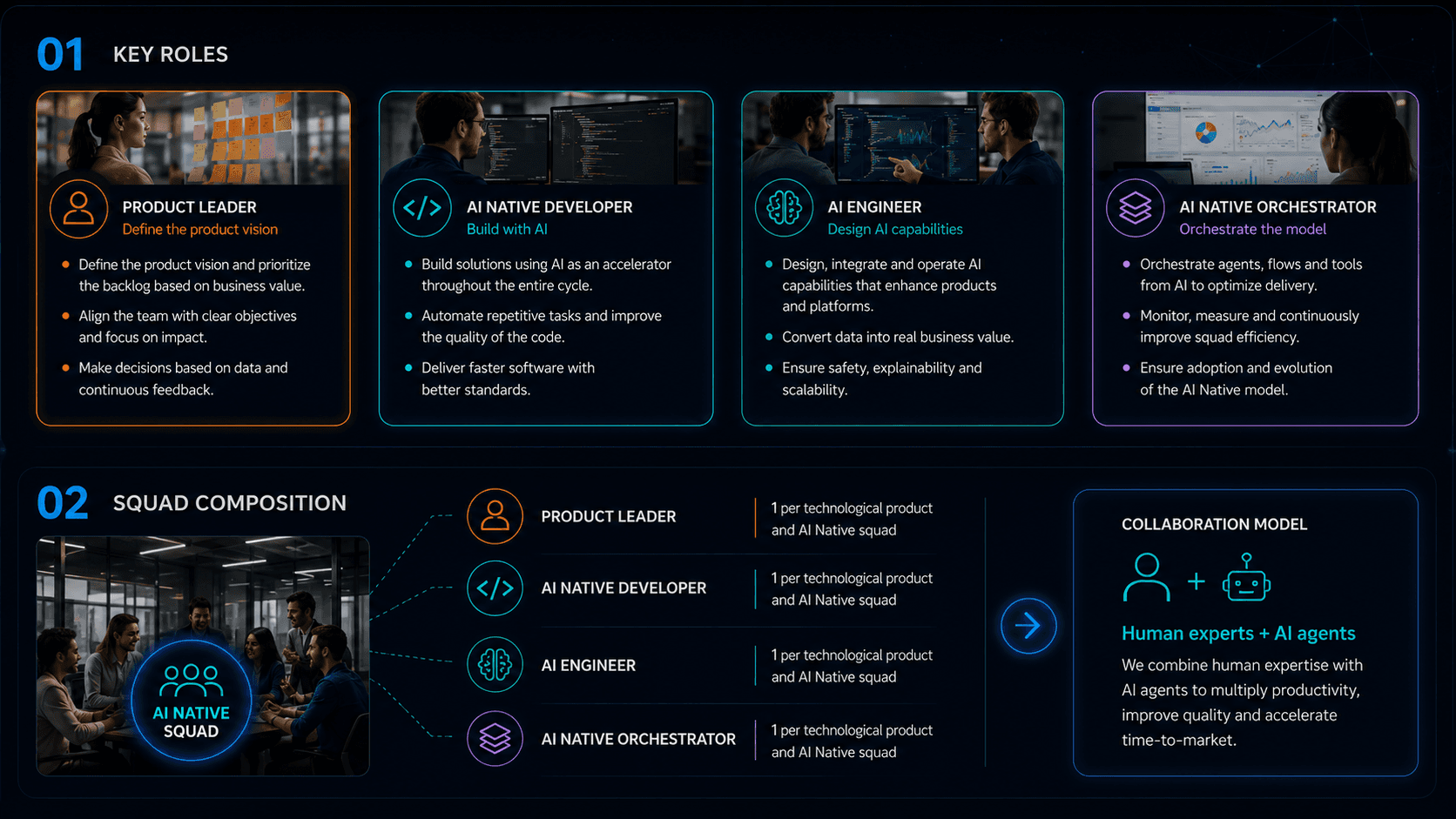
02 / Evolved roles

Current roles mapped to agent-ready responsibilities

I helped design and map current delivery roles into new roles aligned with AI-orchestrated work. The goal was to make the operating model understandable for existing teams while introducing the new capabilities required to build, govern and scale AI agents.

Product LeadAI-native developerAI EngineerAI-native model orchestrator
AI-native role model and squad composition with product lead, AI-native developer, AI engineer and orchestrator

02 / Evolved roles

Current roles mapped to agent-ready responsibilities

AI-native role model and squad composition with product lead, AI-native developer, AI engineer and orchestrator

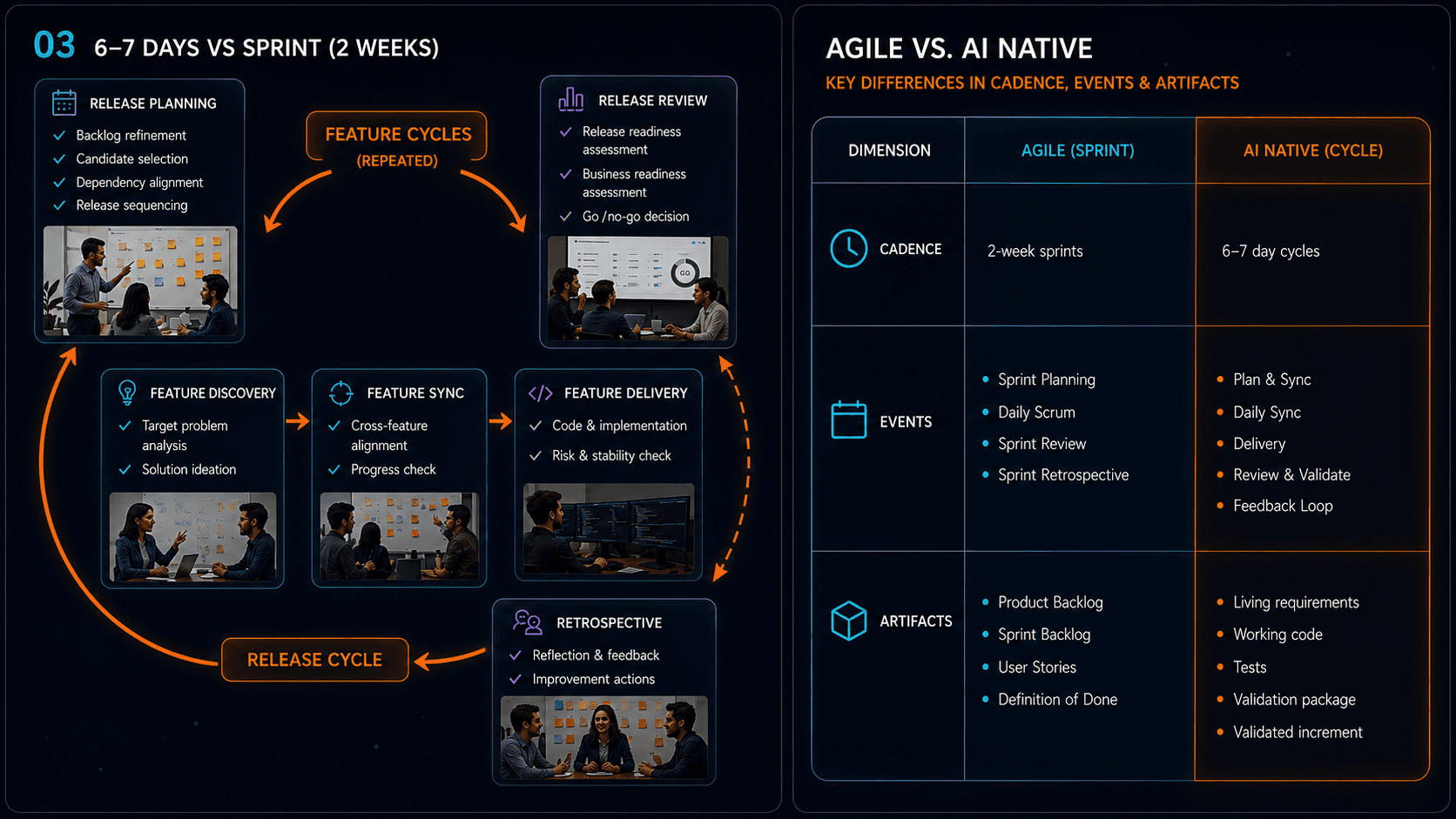
03 / Evolved operating model

Event-based operating model aligned to AI-native SDLC work

I helped evolve, design and implement a new event-based operating model aligned to the SDLC and to the way teams collaborate with agents. The model moves away from long sprint dependency and toward shorter release and feature cycles with explicit planning, delivery, review and feedback events.

Release cycleFeature cycle6-7 day cadenceFeedback and readiness events
AI-native operating model comparing 6-7 day feature cycles with two-week agile sprints

03 / Evolved operating model

Event-based operating model aligned to AI-native SDLC work

AI-native operating model comparing 6-7 day feature cycles with two-week agile sprints

01 / Problem framing

From presales, I translated the bank ambition into an executable AI-native change

A major tier-1 bank wanted to automate its software development lifecycle with AI agents to reduce delivery effort, increase productivity and move faster without losing control. My first contribution was to turn that ambition into a structured transformation proposal instead of a disconnected tooling conversation.

I helped frame the opportunity around business outcomes, engineering cadence and operating constraints. That meant connecting the promise of AI to a banking reality: regulated delivery, multiple squads, approval moments, production readiness and a model that could actually be rolled out across teams rather than remain a proof of concept.

Diagram

Bank objective

Automate the SDLC with AI agents

My starting point

Presales framing and transformation design

Core shift

From tool adoption to delivery model redesign

Why it mattered

The bank needed a model it could scale safely

02 / Transformation logic

I designed the solution around methodology, not only technology

The central design decision was to position AI Native Software Engineering as a methodology evolution. I structured the proposal around three levers that had to move together: the AI stack, the squad and roles model, and the operating model.

This was the key to making the proposal credible. If the bank only added copilots or isolated agents, the impact would remain local. By redesigning the methodology itself, we could connect planning, design, build, testing and release into a new system of work that supported continuous delivery and smaller, more specialized teams.

Diagram

Lever 1

Adapt the technology stack to the client environment

Lever 2

Redesign roles, decision rights and squad composition

Lever 3

Replace sprint logic with AI-native delivery cycles

My contribution

Shape the methodology and make the pieces coherent

03 / SDLC orchestration

I mapped how AI and humans should work across every SDLC phase

Once the transformation logic was clear, I designed how the bank could orchestrate AI support through the whole lifecycle. Planning, designing, development, testing, deployment and production each needed a clear AI role, a human validation point and an expected artifact.

This is where I helped convert strategy into operating detail. Instead of saying that AI would help engineers in general, I defined where it would intervene, what it would produce, which tools would support each phase and where people would validate, approve or refine the output before it moved downstream.

Diagram

Planning stack

Jira, Rovo and Confluence context

Design and build

AI-generated design, code and implementation support

Testing

Automated test generation and validation support

Integration view

Each phase produces approved artifacts for the next one

04 / Roles and operating model

I evolved both the team structure and the delivery cadence

The project required more than new tools. I helped redefine the team model so that the bank could work with AI as a real delivery capability. Product Owner evolved into Product Lead, Developer into Feature Owner, Scrum Master into Operating Model Specialist, and I introduced the new Agent Engineer figure.

At the same time, I designed the operating model as an evolution from agile. Instead of long two-week sprints, the new approach runs a Release cycle and a Feature cycle inside a shorter five-day rhythm. That gives the bank a more continuous flow for discovery, implementation, synchronization, validation and release readiness.

Diagram

Role evolution

Existing responsibilities reshaped around AI-native delivery

New capability

Agent Engineer builds and orchestrates the AI layer

Cadence shift

From 2-week sprints to a 5-day release and feature rhythm

My design work

Align roles, cadence and delivery governance into one model

05 / Integration and implementation

I helped move the bank from design to implementation across teams

The value of the project came from combining methodology, roles, operating model and technology orchestration into a delivery system the bank could implement. My role extended beyond design: I helped connect the proposal to real execution and I am now leading the rollout across teams.

That meant taking the model into integration territory: align the client stack, define how squads would operate, show how AI support enters the lifecycle, create a path for adoption and ensure the model can be repeated. The result is not only a stronger architectural story, but a bank-wide implementation pattern designed to generate major productivity gains.

Diagram

From

Presales, architecture and methodology definition

To

Integration model and implementation across squads

Execution bridge

Adapt the client stack and team model to the new flow

Current state

Leading implementation and scale-out across teams

What this proves

I helped design the methodology, connect it to delivery, and carry it into implementation.

The strongest signal in this project is not a single architecture diagram. It is the ability to move from executive framing to engineering design, from engineering design to operating model, and from operating model to repeatable implementation inside a large banking environment.

I helped shape the bank problem as a transformation of software delivery, not as a narrow AI tooling pilot.
I designed how methodology, technology, roles and cadence had to work together to make AI Native Engineering credible.
I defined how AI and humans interact across planning, design, development, testing, deployment and production.
I evolved the operating model toward continuous delivery and introduced the Agent Engineer figure as a core capability.
I am helping move the proposal into real implementation across teams, which is where the productivity gains are created.
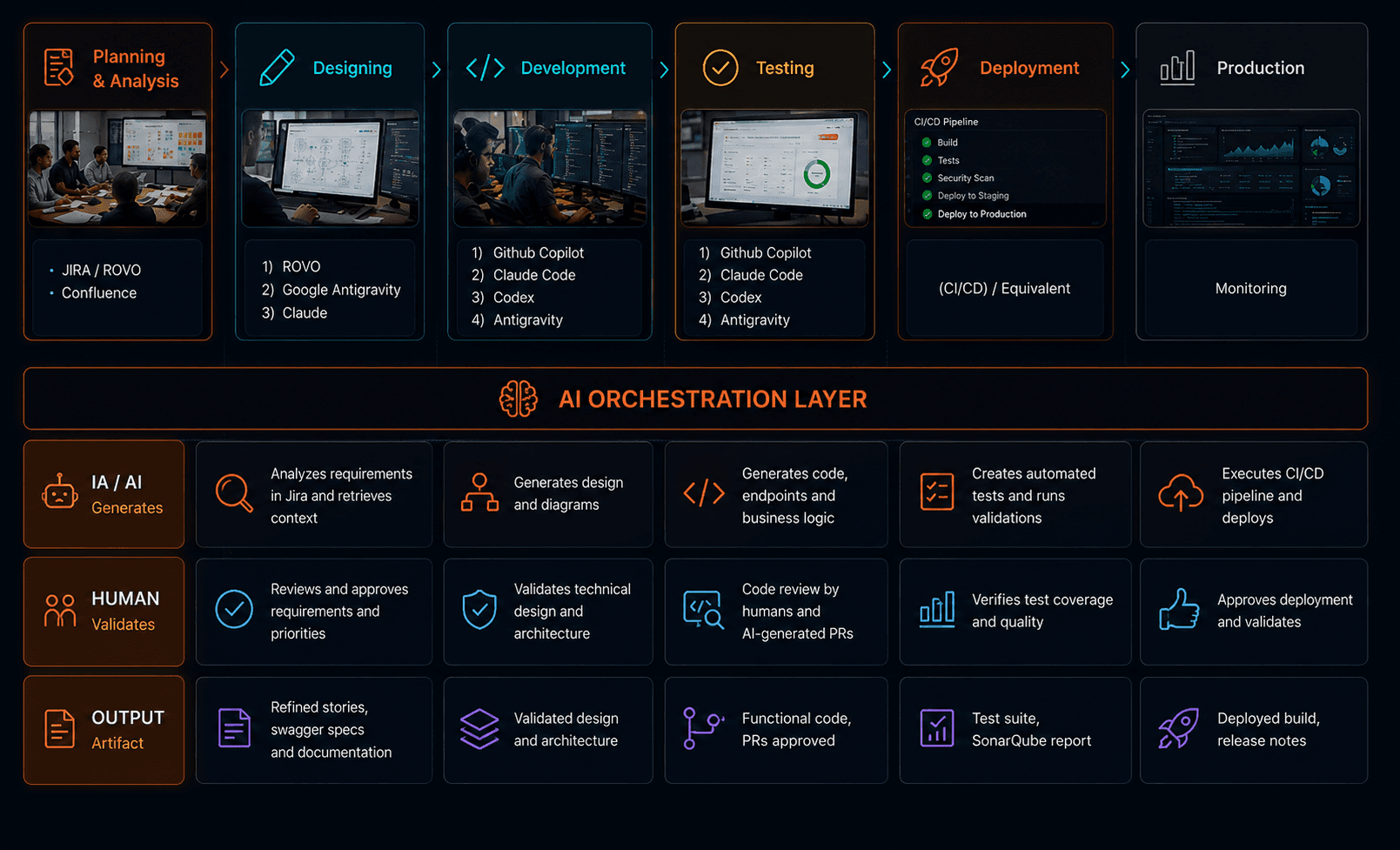
Stack examples used in the proposalJiraRovoConfluenceAntigravityClaudeGitHub CopilotCodexCI/CDMonitoring