Back to evidence

Agentic on-chain transaction safety / technical founder story

How I built an agentic safety layer for natural-language wallet transactions

This project shows the other side of my profile: not only commercial fluency, but hands-on technical depth. I designed and developed a private LangGraph and Web3 project from scratch, where an agent interprets transaction intent while deterministic guardrails decide whether value is allowed to move.

Private GitHub repoAccess by invitation through AI-Explorers-Spain

6

architecture layers

10

LangGraph-style workflow nodes

3

decision paths: approve, confirm, block

100+

unit, integration and adversarial tests

The technical thesis

Better wallet UX is only credible if the agent cannot authorize unsafe transactions by itself.

I built the page around Mermaid diagrams generated from the repository architecture notes: system architecture, LangGraph routing, transaction sequencing, policy controls, risk scoring, API surface, data models and recipient resolution.

01 / System architecture

The complete system architecture I designed and developed

This diagram comes from the repository architecture map and shows the full system I built: CLI and frontend surfaces, FastAPI, TransactionOrchestrator, LangGraph, specialized agent nodes, deterministic guardrails, Web3 execution and external services. It is the strongest proof that the project is not only a concept, but a full technical system.

FastAPI + CLITransactionOrchestratorLangGraph agentsWeb3 execution
High-level system architecture generated from the repository Mermaid diagram

01 / System architecture

The complete system architecture I designed and developed

100%
High-level system architecture generated from the repository Mermaid diagram

02 / LangGraph state machine

The state machine that controls every transaction path

I designed the workflow as a LangGraph state machine so every command has an explicit route: classify intent, answer queries, plan transactions, verify proposals, run guardrails, request human confirmation or execute. This makes the agent auditable instead of a black-box assistant.

StateGraph routingTransaction pathQuery pathBlock and confirm paths
LangGraph state machine generated from the repository Mermaid diagram

02 / LangGraph state machine

The state machine that controls every transaction path

100%
LangGraph state machine generated from the repository Mermaid diagram

03 / Processing sequence

The end-to-end sequence from user intent to on-chain receipt

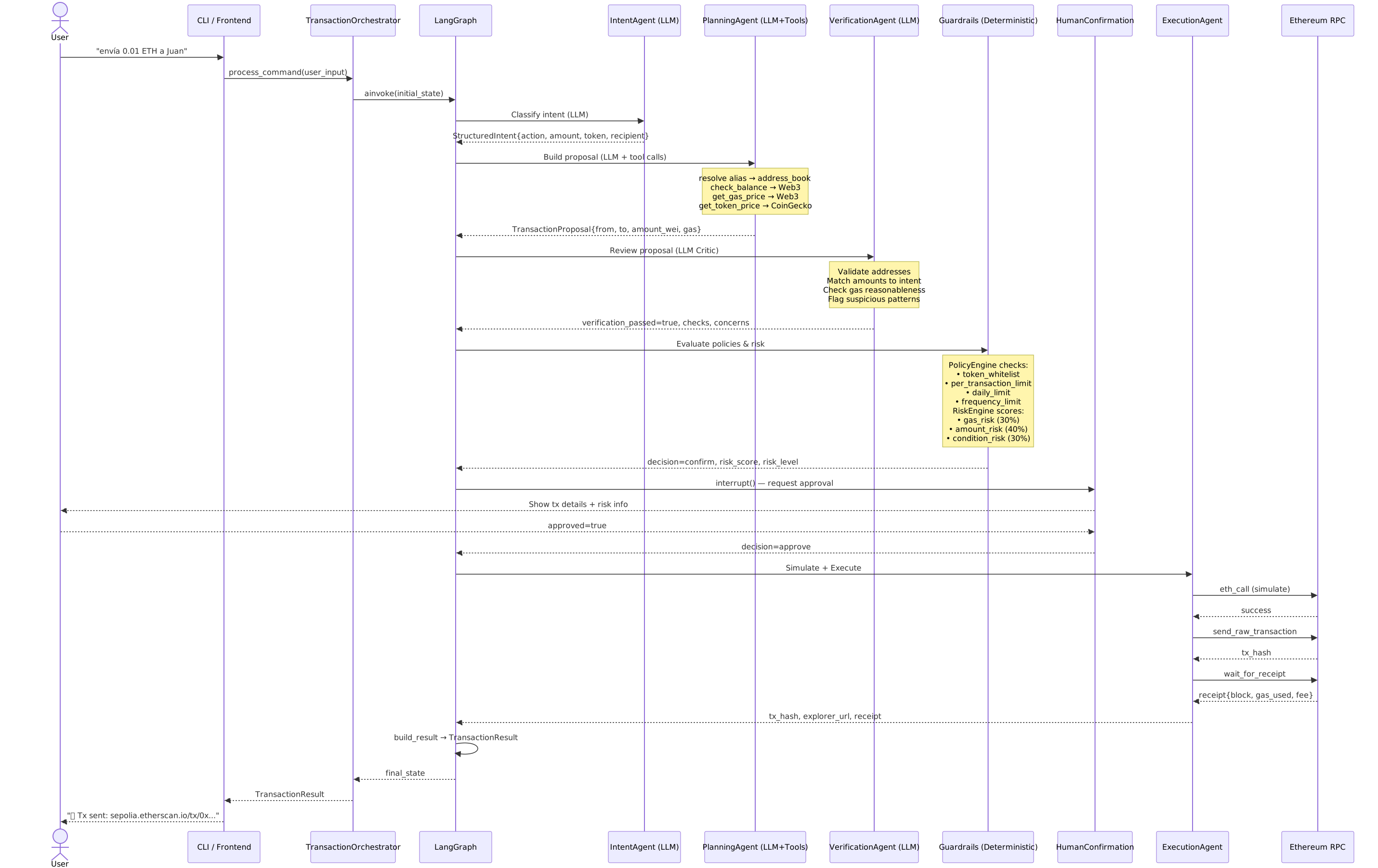
This sequence shows the real execution thinking: the user sends a natural-language instruction, the orchestrator invokes the graph, the LLM classifies and plans, an independent verifier reviews, guardrails decide, the human approves when needed and Web3 returns the transaction hash and receipt.

Intent parsingLLM + tools planningLLM criticEthereum RPC receipt
Detailed transaction processing sequence generated from the repository Mermaid diagram

03 / Processing sequence

The end-to-end sequence from user intent to on-chain receipt

100%
Detailed transaction processing sequence generated from the repository Mermaid diagram

04 / Guardrails decision flow

Policy and risk controls that sit outside the LLM

The safety layer is deterministic. PolicyEngine checks token whitelist, transaction limits, daily caps and frequency. RiskEngine scores gas, amount and conditions. DecisionEngine maps that evidence to BLOCK, CONFIRM or APPROVE. The LLM can propose; it cannot override this flow.

PolicyEngineRiskEngineDecisionEngineApprove / confirm / block
Security and guardrails decision flow generated from the repository Mermaid diagram

04 / Guardrails decision flow

Policy and risk controls that sit outside the LLM

100%
Security and guardrails decision flow generated from the repository Mermaid diagram

05 / Module structure

The repository is organized as a real engineering codebase

This package map shows how I separated the implementation into agents, NLP models, guardrails, blockchain execution, configuration and data modules. The value here is maintainability: each layer has a role, and safety-critical logic is not mixed into prompts.

agents/guardarrailes/blockchain/config/
Module and package structure generated from the repository Mermaid diagram

05 / Module structure

The repository is organized as a real engineering codebase

100%
Module and package structure generated from the repository Mermaid diagram

06 / Data model

Typed transaction objects make the agent inspectable

The data model is a key part of the safety design. StructuredIntent, TransactionProposal, TransactionResult, DecisionReport, PolicyConfig and RiskConfig make every step inspectable. That gives the system a clean boundary between language interpretation and transaction authorization.

StructuredIntentTransactionProposalDecisionReportPolicyConfig
Data model relationships generated from the repository Mermaid diagram

06 / Data model

Typed transaction objects make the agent inspectable

100%
Data model relationships generated from the repository Mermaid diagram

07 / API surface

A usable backend surface for commands, wallet state and settings

I exposed the system through FastAPI endpoints and a WebSocket path: health, command processing, wallet information, settings, address book and transaction history. This matters because it shows the project was designed as an application, not only a notebook or local script.

POST /api/commandGET /api/walletAddress bookWebSocket
API endpoints map generated from the repository Mermaid diagram

07 / API surface

A usable backend surface for commands, wallet state and settings

100%
API endpoints map generated from the repository Mermaid diagram

08 / Intent routing

Bilingual intent classification drives the right execution branch

The agent classifies Spanish or English commands into transaction, price, balance, gas, history, info or unknown intent. That lets the same interface answer safe informational queries while only transaction intents move into planning, verification and guardrail evaluation.

Spanish / EnglishTransaction intentQuery intentsSafe fallback
Intent classification and routing generated from the repository Mermaid diagram

08 / Intent routing

Bilingual intent classification drives the right execution branch

100%
Intent classification and routing generated from the repository Mermaid diagram

09 / Recipient resolution

Address-book controls prevent casual transfers to unauthorized recipients

Recipient resolution is part of the safety design. The system distinguishes raw 0x addresses from known aliases, checks whether addresses are authorized, handles ambiguous aliases and blocks inactive or unknown contacts before planning can continue.

Known aliasesAllowlist checksAmbiguity handlingSafe error paths
Address book and recipient resolution flow generated from the repository Mermaid diagram

09 / Recipient resolution

Address-book controls prevent casual transfers to unauthorized recipients

100%
Address book and recipient resolution flow generated from the repository Mermaid diagram

01 / Why I built it

I wanted to prove that my value is not only commercial fluency

This project is intentionally technical. It shows that I can explain complex AI opportunities to executives, but also design and build the underlying architecture when the domain has real risk. The problem I chose is hard: agents that move assets on-chain from natural-language instructions.

The commercial story is clear: wallets and crypto apps need simpler UX. The engineering reality is harsher: transactions are irreversible, gas-sensitive and exposed to prompt injection, ambiguous intent and user mistakes. I built the project to show both sides together: product narrative, architecture, implementation and evaluation.

Diagram

Signal

I can sell the idea and build the technical argument behind it

Domain

Natural-language wallet transactions and blockchain execution

Risk

Irreversible value movement requires stronger controls than a normal chatbot

Repository

Private GitHub project under AI-Explorers-Spain, available by invitation

02 / Problem framing

The user wants simplicity, but the system must defend the wallet

The research question behind the project is whether a multi-agent system can reduce unwanted or unsafe token transfers while preserving a usable natural-language interface. That tension is the point: too much autonomy is dangerous, too much friction kills the experience.

I scoped the project around token-to-token transfers where the destination is assumed to be known and trusted. That kept the focus on the critical path: understanding how much, which token, when, under what conditions and whether execution is safe.

Diagram

UX goal

Let the user express transfers naturally in Spanish or English

Safety goal

Prevent unsafe, ambiguous or policy-breaking transfers

Scope

Simple token transfers on testnets, with destination identity out of scope

Research lens

Security improvement without unacceptable usability loss

03 / Architecture

The LLM plans, but deterministic components decide

The decisive architectural choice is the boundary between probabilistic reasoning and deterministic authorization. The LLM can classify intent and propose transaction parameters, but policy, risk and final authorization are handled by separate engines.

That boundary matters because prompt injection should not become financial authorization. Even if an LLM is confused, manipulated or overly helpful, it cannot bypass token whitelists, amount limits, daily caps, frequency constraints or risk thresholds.

Diagram

Agent layer

Intent, planning and verification use language reasoning

Security layer

PolicyEngine, RiskEngine and DecisionEngine stay deterministic

Execution layer

EOA wallet and executor handle simulation, signing, sending and receipts

Design principle

The model proposes; the system authorizes

04 / Implementation detail

I designed the system as an inspectable engineering project

The repository is not a static concept deck. It includes the technical structure, the research framing, implementation modules, test strategy and a development plan for hardening the codebase after analysis.

The engineering plan covers data integrity, configuration wiring, RPC setup, async Web3 correctness, dead-code cleanup, type safety and adversarial test improvements. That is the part I want visible: I am comfortable moving from strategy to the messy engineering details that decide whether an AI system is trustworthy.

Diagram

Implementation

Python, LangGraph, Web3 and structured policy/risk modules

Quality mindset

Tests cover unit, integration and adversarial behavior

Hardening

Development plan identifies concrete fixes and acceptance criteria

Candidate signal

I can discuss architecture and also review implementation risk

05 / Evidence

The evaluation focuses on failure modes, not only successful transfers

For this type of system, a successful transaction is not enough evidence. The relevant question is what happens when the instruction is ambiguous, hostile, too expensive, too frequent or outside the user policy.

The project evaluates prompt injection, policy bypass attempts, risky destinations, gas conditions and confirmation paths. I also document limits clearly: testnet-first, no broad mainnet claim, and no claim that application guardrails replace full wallet, network or operational security.

Diagram

Security evidence

Adversarial cases try to bypass restrictions

Usability evidence

Adaptive HITL reduces unnecessary confirmation fatigue

Honesty

The page states scope and limits instead of overclaiming production readiness

Recruiter signal

This is hands-on AI safety, not only customer-facing language

What this proves

I can connect commercial narrative with technical execution.

The strongest signal is the combination: I can explain why agentic wallet UX matters, then go into the architecture, implementation, evaluation and hardening work needed to make it credible.

I created a private technical project that converts natural language into on-chain transaction proposals with a safety-first architecture.
I separated LLM planning from deterministic authorization, which is the key pattern for trustworthy agentic systems.
I designed policy, risk and decision engines that can approve, request confirmation or block transactions with explicit reasons.
I evaluated the system with adversarial scenarios because unsafe agent behavior usually appears outside the happy path.
I can explain the business value of better crypto UX while still going deep into LangGraph, Web3, tests and implementation risk.
Technical stackLangGraphPythonWeb3.pyGPT-4o-miniSepoliaPolicyEngineRiskEngineDecisionEnginePydanticpytestPrompt injection testsHuman-in-the-loop